


Greetings.
This resource page provides practical, preventative safety guidance designed for special needs individuals, families, caregivers, and support networks. Visitors can learn how to discuss and recognize predatory behavior, identify possible signs of trafficking within the community, and understand when and how to safely involve law enforcement or other authorities.
The page also introduces personal and family code words, internationally recognized signals for help, strategies for recognizing and leaving dangerous situations, and clear reporting options when something does not feel right. Additional guidance explains where to seek medical care, advocacy, reporting assistance, and trauma-informed support following sexual assault. The goal is to make personal safety information understandable, actionable, and accessible while helping individuals build confidence in recognizing danger, communicating concerns, and asking for help.
South Carolina click here
Northern Virginia click here
- OR -
Download Document with Complete List:
Virginia South Carolina
Resource List
1. Reporting suspected trafficking in Loudoun County and Northern Virginia
2. Anonymous reporting apps and digital tools
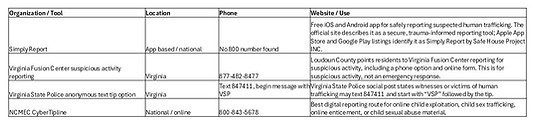
3. If a violent crime or sexual assault has occurred: where to go and what to expect

4. Trauma response counseling online
5. EMDR therapy in Northern Virginia
EMDR therapy stands for Eye Movement Desensitization and Reprocessing. It is a structured, clinician-led trauma therapy that helps a person process painful or frightening memories so the memory becomes less overwhelming. EMDR is often used for PTSD, sexual assault trauma, anxiety, grief, medical trauma, and other distressing experiences. The therapist may use side-to-side eye movements, tapping, sounds, or another form of “bilateral stimulation” while the person briefly focuses on the memory in a safe, guided way.
For a Down syndrome individual, EMDR may help by reducing the fear, panic, shutdown, nightmares, avoidance, aggression, regression, or body-based distress that can follow trauma. This matters because some people with Down syndrome may not explain trauma in long verbal detail, but their body and behavior may show it through sleep changes, clinging, new fears, bathroom regression, refusal to go places, sudden anger, sadness, or loss of skills. NDSS notes that people with Down syndrome can experience mental health concerns such as anxiety, depression, obsessive behaviors, and oppositional behaviors, so trauma treatment should be adapted to the person’s communication and developmental needs.
Screening questions for EMDR providers:
Ask whether the therapist has experience with intellectual/developmental disabilities, Down syndrome, autism, communication differences, sexual assault trauma, caregiver involvement, and court/victim-service documentation. For some Down syndrome individuals, standard EMDR may need pacing, visual supports, caregiver coordination, or a modified trauma protocol.

6. Disability and Down Syndrome Support Services (National)

South Carolina Residents:
Able South Carolina, Violence Prevention and Survivor Services: Able South Carolina serves residents statewide, with offices in Columbia and Greenville. The Columbia office can be reached at 803-779-5121 or 800-681-6805, and the Greenville office at 864-235-1421. Its Violence Prevention and Survivor Services program is specifically designed for people with disabilities and provides peer support, safety-resource navigation, disability-rights information, and connections to appropriate services. The organization also provides guidance concerning abuse and assault involving people with disabilities, interactions with law enforcement for people with intellectual and developmental disabilities, human trafficking, and survivor advocacy. Able SC is not an emergency or crisis-response service.
Disability Rights South Carolina, DRSC: Disability Rights South Carolina is the state's federally designated Protection and Advocacy organization for people with disabilities. Based in Columbia and serving residents statewide, DRSC can be reached through its Help Line at 866-275-7273 or its main office at 803-782-0639. The organization assists with allegations involving abuse, neglect, exploitation, discrimination, and violations of disability rights. Services may include information and referral, self-advocacy assistance, investigation, advocacy, and, in qualifying circumstances, legal representation. DRSC can be especially helpful when suspected exploitation involves a caregiver, residential provider, institution, disability-service agency, or other person responsible for the individual's care or resources.
South Carolina Department of Behavioral Health and Developmental Disabilities, Office of Intellectual and Developmental Disabilities, BHDD-OIDD: BHDD-OIDD serves individuals with intellectual and developmental disabilities throughout South Carolina and can be reached at 803-898-9600. The agency provides specific reporting pathways for suspected abuse, neglect, or exploitation involving people with developmental disabilities. Reports involving adults living in certain state-supported residential settings may be directed to the South Carolina Law Enforcement Division's Vulnerable Adult Investigations Unit at 866-200-6066. Concerns involving vulnerable adults living in the community may be reported through Adult Protective Services at 803-898-7318, option 3. Separate reporting procedures apply when the individual is a minor.
Family Connection of South Carolina: Family Connection serves families of children and individuals with disabilities or special health-care needs throughout South Carolina. The organization can be reached at 800-578-8750, with Spanish-language assistance available at 888-808-7462. Its Support and Information services help families locate appropriate disability resources, understand available services, navigate state systems, and connect with other families. Family Connection may be particularly useful when a caregiver needs help locating disability-informed services following suspected predatory behavior, abuse, or exploitation. It is not an investigative or emergency-response agency.
The Arc of South Carolina: The Arc of South Carolina serves people with intellectual and developmental disabilities and their families statewide and can be reached at 803-748-5020. The organization provides advocacy, case management, education, community programs, and assistance navigating disability services. Its work includes protecting the rights and safety of people with intellectual and developmental disabilities. The Arc also provides emergency-response education intended to improve interactions between first responders and people with disabilities. It is best used as an advocacy and service-navigation resource rather than an emergency reporting agency.
Down Syndrome Association of the Lowcountry: The Down Syndrome Association of the Lowcountry serves individuals with Down syndrome and their families in Charleston and surrounding Lowcountry communities. The organization can be reached at 843-654-1552. It provides education, family connections, advocacy, social support, and community resources. Families dealing with suspected predatory behavior, exploitation, or other safety concerns may use the organization as a trusted local connection for locating disability-informed services and support. It does not function as a law-enforcement or crime-reporting agency.
Down Syndrome Families of the Midlands: Down Syndrome Families of the Midlands serves people with Down syndrome and their families in the Columbia, Lexington, and Midlands region. The organization focuses on advocacy, inclusion, family support, education, and community connections. Families may contact the organization through its website or public contact channels for assistance connecting with regional resources. It can provide community and family support while specialized law-enforcement, protective-services, medical, or disability-rights agencies address a reported incident.
Down Syndrome Association of the Upstate: The Down Syndrome Association of the Upstate serves individuals with Down syndrome and their families throughout Greenville and the Upstate region. The organization can be contacted through info@dsaupstate.org. It provides family support, advocacy, education, community programming, and connections to local resources. For families confronting suspected exploitation or predatory behavior, the association can help connect them with disability-informed community services while appropriate authorities or specialized victim-service agencies address the underlying safety concern.

What to expect at the hospital or forensic exam site
In Virginia, the evidence collection kit is commonly called a PERK, or Physical Evidence Recovery Kit. A survivor can seek medical care for injuries, pregnancy concerns, STI/HIV concerns, and evidence collection. Virginia’s SAFE program states that sexual assault victims have the right to evidence collection at no cost and may have a PERK collected without filing a police report.
The process may involve emergency medical triage first, then contact with a forensic nurse or FACT team. Inova FACT says to call 703-776-6666 for information about evidence collection or to schedule a forensic exam, and if no one answers, call 703-776-2199 and ask the operator to page the FACT nurse or child abuse physician on call, if the incident involves a minor.
For a Down syndrome individual, families should ask for a victim advocate, communication accommodations, plain-language explanations, extra processing time, and permission for a trusted support person when appropriate. For minors, guardianship issues, or adults who may be legally incapacitated, call LAWS, FACT, CPS, APS, or RAINN before arrival when possible so the family does not have to navigate consent and reporting alone.

Loudoun County Residents:
Summary
For a suspected trafficking situation in Loudoun County: call 911 if immediate danger, otherwise call Loudoun Sheriff non-emergency 703-777-1021, then also report to the National Human Trafficking Hotline 888-373-7888 or Virginia trafficking response line 833-463-6448.
For a recent sexual assault or violent crime: call 911 if unsafe or injured, call LAWS 703-777-6552 for a local advocate, and call Inova FACT 703-776-6666 for forensic exam guidance.
For a Down syndrome adult who may be exploited or unable to self-protect: call 911 if immediate danger, APS 888-832-3858 for abuse/exploitation concerns, and The Arc of Loudoun or The Arc of Northern Virginia for disability advocacy support.

Disclaimer
Legal Disclaimer: This website and its resources are provided for educational and informational purposes only and do not constitute legal, medical, law-enforcement, investigative, or professional advice. Information and third-party resources may change, and no guarantee is made regarding their accuracy, availability, or suitability for any individual situation. Users are responsible for contacting appropriate authorities, qualified professionals, or emergency services and for complying with applicable reporting requirements in Virginia, North Carolina, South Carolina, or their jurisdiction. In an immediate emergency, contact 911. To the fullest extent permitted by law, the website owner and affiliated organization disclaim liability arising from reliance upon or use of this information. (Last update: August 12, 2026)